
24-Hour Heart Monitor Assessment in Essex & London | Dr Cook
What is a 24-Hour Heart Monitor (Holter)?
A Holter monitor (or ambulatory ECG) is a portable device used to record your heart rhythm continuously over a longer period—usually 24 hours, but sometimes for several days. This essential diagnostic tool captures heart rhythm changes that may not appear during a standard, short-term clinic ECG.
How Does a 24-Hour Heart Monitor Work?
The test is entirely painless and non-invasive. During your appointment:
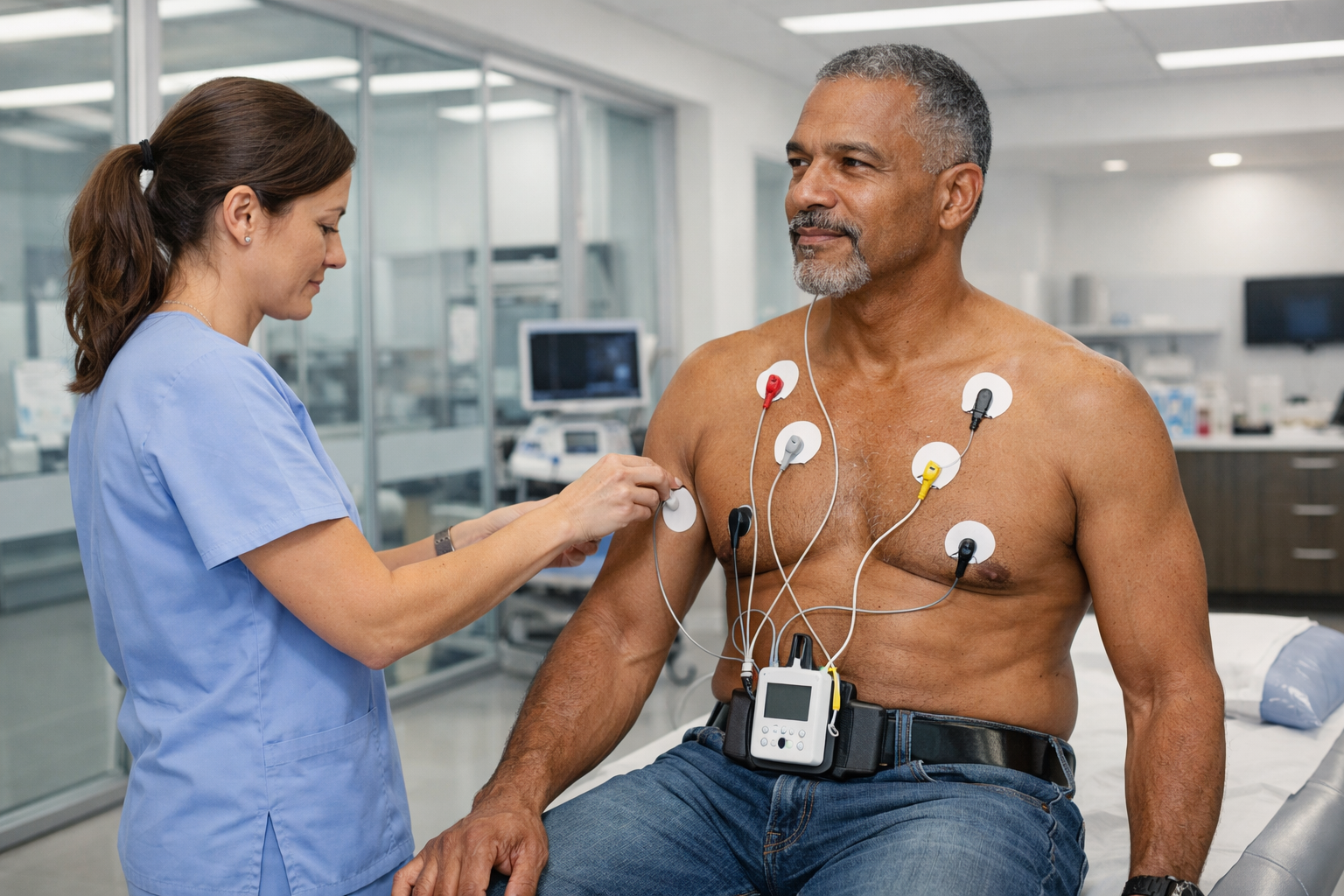
Small, sticky electrodes are placed on your chest.
These are connected to a lightweight portable recorder worn on a belt or shoulder strap.
You simply go about your normal daily activities while the device continuously monitors your heart rate and rhythm.
Why is a Holter Monitor Recommended?
Because many heart rhythm disturbances (arrhythmias) are intermittent, they can be difficult to "catch" during a brief consultation. A 24-hour heart monitor is the gold standard for investigating:
Heart Palpitations: Identifying "fluttering" or "skipped beats" that occur throughout the day or night.
Dizziness & Fainting: Checking if light-headedness is caused by a heart rate that is too slow or too fast.
Unexplained Breathlessness: Evaluating how your heart rhythm responds to physical exertion.
Recording Your Symptoms
During the monitoring period, you may be asked to keep a brief symptom diary. This allows us to accurately link any sensations of palpitations or dizziness with the exact electrical activity of your heart at that moment. By combining this data with an expert clinical review, I can provide a precise diagnosis and a personalised heart care plan tailored to your needs.
Why would I be offered ambulatory ECG monitoring?
Ambulatory ECG monitoring (often called a Holter monitor) is a vital diagnostic tool used to investigate symptoms that may not appear during a brief clinic appointment. I use this continuous recording to provide a clear diagnosis for:
Heart Palpitations: Identifying "fluttering," "racing," or "skipped beats."
Dizziness & Light-headedness: Checking for heart rate drops or spikes.
Blackouts (Syncope): Investigating if a loss of consciousness is related to a heart rhythm issue.
Unexplained Breathlessness: Evaluating how your heart rhythm responds to daily activity.
What Does a 24-Hour Monitor Detect?
By recording your heart's electrical activity during your everyday life, this test helps to identify:
Abnormal Heart Rhythms (Arrhythmias): Such as Atrial Fibrillation (AFib).
Ectopic Beats: Identifying "extra" or "missed" beats that cause discomfort.
Heart Pauses: Detecting moments where the heart rate slows significantly.
Monitoring & Clinical Reassurance
Beyond diagnosing new symptoms, 24-hour heart monitoring is frequently used to:
Assess Known Rhythm Problems: Tracking the frequency of an existing arrhythmia.
Monitor Treatment Response: Evaluating how well a new medication or procedure is controlling your heart rate.
Provide Clinical Reassurance: Confirming that your heart rhythm is normal during episodes of symptoms, providing peace of mind.
Expert Analysis for Your Care Plan
The results of your Holter monitor play an essential role in guiding your personalised heart care plan. By combining these findings with your medical history and clinical examination, I can determine the most appropriate next steps—whether that involves simple reassurance, lifestyle changes, or specialist treatment.
Book Your Consultation
Consultant-led private cardiology in Essex and London. Rapid appointments, no GP referral required.
Self-pay and all major insurers accepted (BUPA, AVIVA, AXA, Vitality, Allianz, and WPA).



Book Online Now
For self-funding patients, an initial consultation is £250 and a follow up consultation is £200.